In this guide, I’m going to give you the lowdown on the must-visit places in Rome one of the world’s most famous cities, renowned for its rich heritage, iconic landmarks, and romantic restaurants. I’ll tell you all about the city’s most famous attractions, what each of them has to offer, and how much time you’ll need to allocate to visit them. So, without further ado, let’s get into it.
The Colosseum
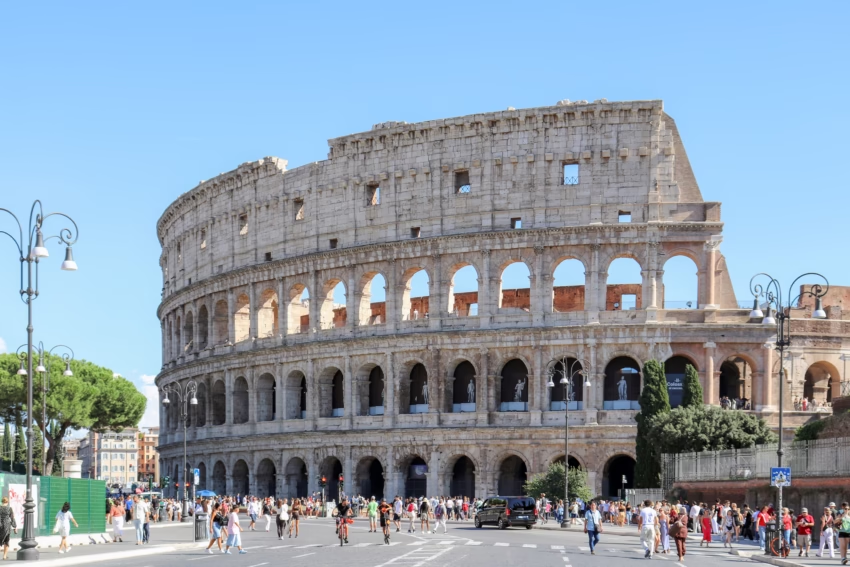
Arguably Rome’s most famous attraction, you’ll likely already know all about the Colosseum. Designed to host gladiatorial fights and games, the Colosseum was the centre of spectacle in ancient Rome.
Because it’s so busy, I would highly recommend booking your tickets a couple of days in advance; it’ll save you standing in a queue for hours on end in the scorching heat, and oftentimes is considerably cheaper. Once you’re inside and through security, you can expect to find yourself face-to-face with the Colosseum’s dramatic interior, where rows of ancient stands and stone seating loom over the stadium’s central stage, where now, you can pay a little extra to walk out onto the central viewing platform.
Once you’ve taken plenty of photos and walked all the way around that central stage, you’ll walk upstairs and be treated to the museum area, where you can learn more about the games that took place in Rome, how it came to be, and how it has been restored in recent years. You can also learn more about Rome generally, as the museum dives deep into the origins of Rome itself.
Make sure you give yourself 2-3 hours overall to get the most out of the Colosseum; you’ll need it.
The Roman Forum and Palatine Hill
Either before or after you visit the Colosseum, you need to visit the Roman Forum and Palatine Hill, both of which are included in your ticket for the Colosseum. Immerse yourself in the Roman Empire, as you explore the thousand-year-old ruins of ancient temples, government buildings, and public arches, like the Temple of Saturn and the Arch of Titus. If you’re visiting in summer, make sure that you’re hydrated, as there is very little shade in the forum.
Once you reach the back half of the forum, you’ll be able to see Palatine Hill on the right-hand side. This used to be home to various imperial palaces and is the birthplace of the city as a whole, where it is said that twins Romulus and Remus were found by a she-wolf, leading Romulus to found the city of Rome there in 753 BC.
You’ll only need an hour, maybe 90 minutes tops, in the forum.
The Vatican (and Vatican Museum)
While you’re in Rome, you may as well visit the world’s smallest country. The Vatican is obviously a state in its own right, and is the home of the Catholic Church and residence of the sitting Pope, but you don’t need to be Catholic to enjoy it.
In fact, I’d recommend a guided tour for this one, just to get the most out of it. Having those extra pieces of contextual information really helps you appreciate the significance of the grand, golden halls you walk through.
St Peter’s Basilica itself is a surreal place. Home to masterworks of Bernini and Michelangelo, walking through the church makes you feel as if you’ve just walked through the pearly gates, what with its 100ft-high ceilings encrusted with gold, mosaic depictions of angels and saints. This centuries-old wonder is almost perfectly preserved, from the tip of the Michelangelo-designed dome to its underground grotto.
Don’t forget to pop around the corner from the basilica to visit the Vatican Museum. These seemingly endless, often sprawling exhibits will be enough to astonish and fascinate everyone, from fans of history to even the most cynical atheists. My favourite exhibits were those dedicated to Ancient Egypt and Ancient Rome, but the highlight was definitely the world-renowned Sistine Chapel, where the walls and ceilings beautifully depict many of the Bible’s most famous events with artful precision.
You’re going to need a full day to get the most out of the Vatican, especially as it’s located far away from many of Rome’s other attractions.
Find a Pizzeria in Trastevere
Now it’s time for a bit of a break from the honeypots. Sure, they’re some of the best honeypots in the world, but they’re still honeypots. You probably want a slightly more authentic taste of Rome, so I would highly recommend a walk through Trastevere, which is home to many of Rome’s finest long-standing restaurants.
The food here is so good, I’d be happy for any one of them to prepare my hypothetical death row meal, no problem. The best pizza, pasta, and gelatos in the world, all set in the sleepy confines of narrow medieval alleyways and to a soundtrack of violinists performing on street corners and muted conversations, with the occasional burst of raucous laughter.
Always Enter a Random Church
This is another smaller one, but when you’re trekking through the city, if you ever happen across a seemingly random church or temple, I’d highly recommend that you go inside. Even the quietest corners of Rome have an overabundance of ancient churches, home to mosaics, paintings, and statues that would be considered masterpieces if they were in any other country. Though many may be undergoing building work, don’t let the scaffolding, diggers, or the odd concrete breaker put you off. These smaller churches are Rome’s true hidden gems.
The Trevi Fountain and Spanish Steps
Speaking of hidden gems, you may have heard of the Trevi Fountain and Spanish Steps. Obviously, you have. These two are best enjoyed with a gelato in hand, as you wander through Rome’s narrow cobblestone streets, to suddenly be created by a marble masterpiece – or travertine stone, in the case of the Spanish Steps.
You won’t need to allocate much time to either of these locations I would recommend incorporating them into your general exploration of the city.
Rounding Off
Hopefully, this guide will help you plan your next trip to the Italian capital, and you’ll be able to strike the right balance between seeing those must-visit landmarks and getting a feel for the quieter parts of town.