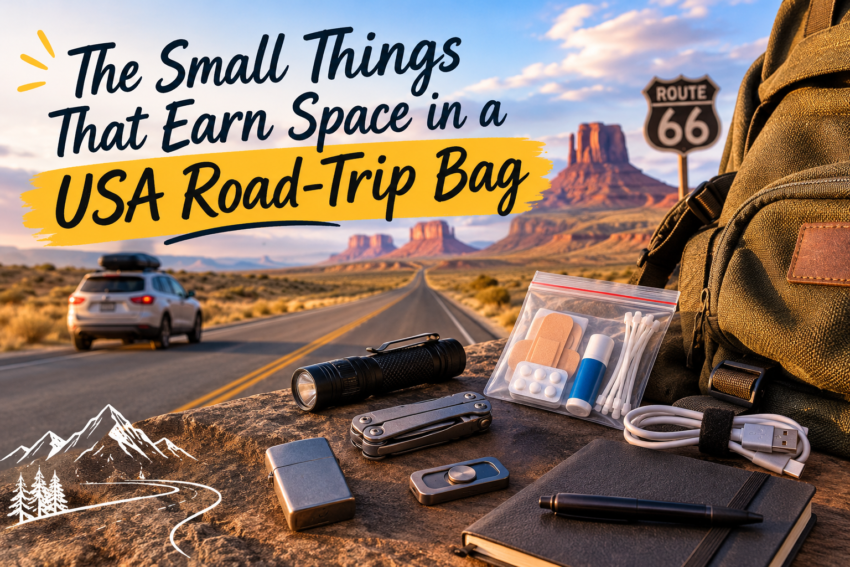
There is a point on every long American drive — somewhere past the second gas station, when
the novelty of the open road has worn off and the car has settled into its hum — when you find
out what you actually packed well.
It is never the big stuff. The big stuff you planned for. It is the small things: the ones that were in
your bag because you grabbed them without thinking, or the ones you left behind and spent the
next three hundred miles wishing you hadn’t.
I make small, hand-finished everyday-carry pieces for a living, so I think about pocket-sized
objects more than most people. But the lesson here isn’t about my work. It’s about a simple
packing rule I have learned on road trips across the States: if a small thing doesn’t earn its space
by the second day, it doesn’t belong in the bag at all.
Pack for the stops, not the drive
Most people pack for the hours behind the wheel. That’s the easy part — you need almost
nothing while driving. The bag earns its keep at the stops: the trailhead outside Moab where the
wind picks up, the picnic table at a rest area in Kansas, the motel parking lot at 9 p.m. when
something needs fixing and the stores are closed.
So I start with the stops. What will I actually reach for?
A small flashlight, because trailhead parking lots and rural rest stops get dark in a way city
people forget. A pocketknife or a small multitool, because road trips are held together with
small jobs — cutting a tag off a new shirt, opening a package, tightening a loose screw on a
cooler latch. A lighter or a small fire starter if you’re camping. A charging cable that actually
works, and a spare, because the one you rely on will fail at the worst moment — usually in the
middle of nowhere in Nevada.
None of this is new advice. The point is proportion: these things are small, light, and they solve
real problems. A bag full of “just in case” gear that never gets used is worse than a light bag,
because you stop being able to find the thing you actually need.
The test: would I miss it by mile 200?
Before a trip, I lay everything out and ask one question about each item: if I left this behind,
would I miss it before the first overnight stop?
If the answer is no, it stays home. If the answer is “maybe,” it stays home too. “Maybe” is how
bags get heavy.
What survives the test, trip after trip:
A small multitool. Not a toolbox — one compact tool that covers cutting, opening, and the
odd screw. On a road trip, the jobs are always small. The tool should be too.
A light you can hold in your teeth. Or clip to a hat. When you’re setting up camp after dark
or looking under a car seat, both hands matter.
Something to fidget with. This one surprises people, but long drives and long waits are
when your hands get restless. A small mechanical slider or a worry stone — something
quiet, something that fits in a pocket — makes the waiting parts of a trip easier. It sounds
trivial until you’ve spent four hours as a passenger on I-40.
A zip bag with the boring essentials. A couple of bandages, painkillers, lip balm, a few cable
ties. The whole kit weighs nothing and lives in the bottom of the bag. You will use it once a
trip, and that once will be the moment you’re glad it’s there.
A notebook and a pen that works in the cold. Phones die. A paper list of addresses,
reservation numbers, and the name of the place you’re staying doesn’t.
Notice what’s not on the list: the third charging brick, the full-size anything, the gadget you
bought for the trip and have never used. Road-trip packing rewards the things you already reach
for every day.
One bag, one pocket, one rule
Here’s the habit that changed my packing more than any checklist: everything I might need
while the car is moving goes in one pocket of the bag. Not scattered — one pocket. Sunglasses,
lip balm, the charging cable, the small light, the fidget piece. When we stop, I grab that pocket’s
contents and nothing else.
The rest of the bag can stay packed. The cooler stays shut. The suitcase stays in the trunk. A road
trip goes better when the bag is organized around access, not volume.
It also makes repacking honest. At the end of the trip, whatever is still untouched in that pocket
goes on a mental list — not “pack it next time,” but “do I even own this for a reason?” Most of
us carry a few items out of habit rather than need. A road trip is a good audit.
The souvenir test
There’s a second test I apply on the way home: the souvenir test. The best road-trip purchases
are small, well-made, and useful — the kind of thing you actually carry after the trip ends. A
pocketknife from a small-town hardware store. A handmade piece from a roadside maker. The
things that end up in a drawer by Christmas were never worth the space in the bag.
That is, in the end, what the small things in a road-trip bag are for. Not to impress anyone, and
not to prepare for every scenario. Just to make the long miles easier, the stops smoother, and
the drive home a little lighter than the drive out.
Pack light. Pack what you reach for. And leave room — in the bag and in the schedule — for the
stop you didn’t plan.
Mu is a maker who hand-finishes small everyday-carry pieces, one at a time. He writes about
pocket gear and the making process on the M-EDC blog, and his work is at M-EDC.